
The Smartest Billboard in Miami Barely Said Anything
A minimalist billboard in Miami sparked a deeper reflection on integrated marketing, consumer behavior, and why the strongest campaigns today often say the least.
5/13/20262 min read
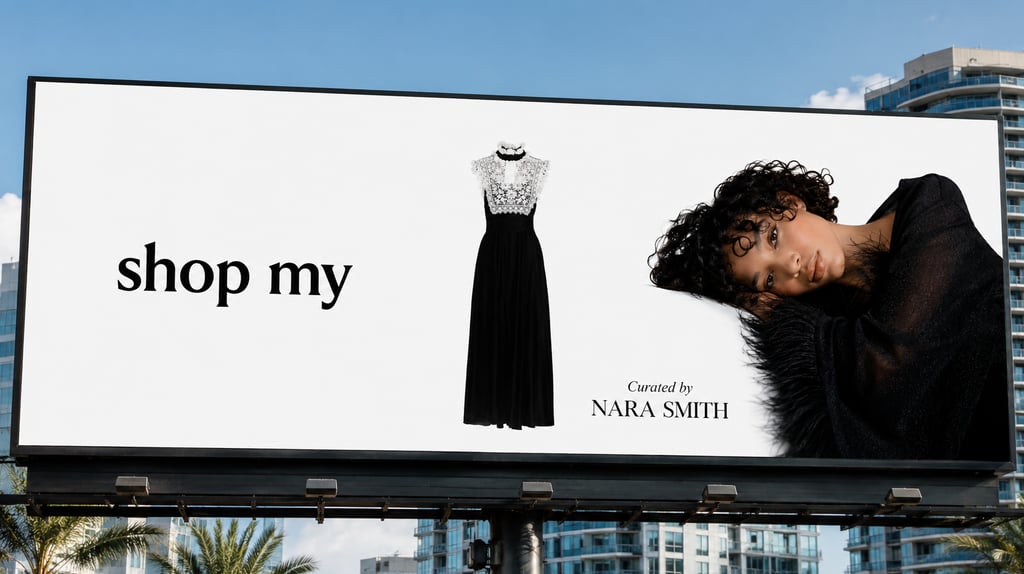

Editorial recreation inspired by a real billboard campaign observed in Miami
Driving through Brickell a few days ago, one billboard completely hijacked my attention. Which is ironic, because it barely said anything.
White background. Black dress. A familiar face. Minimal text. No giant CTA screaming for attention. No overloaded copy. No QR code fighting for clicks every three seconds.
And somehow… it worked better than most ads do.
As someone fascinated by branding, communication, and consumer behavior, I found myself thinking about that billboard long after I drove away. Which rarely happens to me with advertising.
It reminded me that the strongest marketing campaigns today don’t always look like marketing. Great branding shortens the distance between attention and understanding. The right audience will understand.
When Simplicity Wins Attention
The billboard stayed in my head not because it explained more, but because it assumed more.
It assumed people would recognize celebrity culture, understand the luxury resale ecosystem, get curious, search the brand online, and continue the experience digitally on their own.
Which, honestly, says a lot.
Eventually I looked it up and discovered the company behind it was ShopMy, a platform built around creator-driven shopping and curated recommendations. But the interesting part wasn’t the platform itself. It was the communication strategy behind it.
What looked like a simple billboard was actually a sophisticated example of integrated marketing.
The billboard itself was traditional media: physical, static, placed directly into the real world. But its purpose wasn’t to close the sale right there on the street. Its purpose was to trigger a digital behavior pattern that already exists in consumers.
Google it.
Search it.
Discuss it.
Explore it.
Continue the journey online.
That’s sophisticated marketing strategy.
Traditional vs. Digital Communication
One of the biggest differences between traditional and digital communication today is how each interacts with the audience.
Traditional media has historically been more one-directional: brands push messages outward and audiences receive them. Billboards, magazines, radio, and television are designed to create awareness and visibility, often communicating to broad audiences at once.
Digital communication, on the other hand, is interactive. It creates feedback loops, tracks behavior, personalizes experiences, and allows brands to guide customers through an ongoing journey instead of a single moment of exposure.
The smartest brands today understand that these two worlds are no longer separate.
Modern marketing is no longer about choosing between traditional and digital communication. The real power lives in the connection between both.
Where Creativity Meets Behavioral Intelligence
What makes campaigns like this even more fascinating is that the simplicity is probably backed by an enormous amount of strategy, analytics, behavioral insight, and audience understanding.
A minimalist billboard only works when a brand deeply understands:
who it’s talking to,
how that audience behaves online,
what cultural references resonate,
and how consumers naturally move between physical and digital spaces.
That’s the part people often miss: great modern marketing is rarely just creative. It’s creativity informed by behavioral intelligence.
As AI and data tools continue making audience behavior easier to analyze, the brands that will stand out won’t necessarily be the loudest ones. They’ll be the ones capable of turning insight into communication that feels intuitive, culturally aware, and almost frictionless.
Final Thought
In a world overloaded with content, the smartest brands may be the ones that understand exactly how consumers already move between physical and digital spaces — and quietly meet them there.
That might be the real flex.
Ginosca Cedeño
Building at the intersection of creative strategy, systems thinking, branding & AI.
References
Chaffey, D., & Ellis-Chadwick, F. Digital Marketing (7th Edition). Pearson Education.
Smart Insights – RACE Planning Framework.
ShopMy campaign observations (Miami, 2026).

